Current Product
Clad
AI personal color service
Clad turns a submitted photo into a personal colour card — the season, the colours that suit, and the ones better kept away from the face. When several photos disagree it says so and explains what it judged from, and it shows no score anywhere.
- Multi-photo agreement
- Colour held against your own photo
- Lip check on its own scale
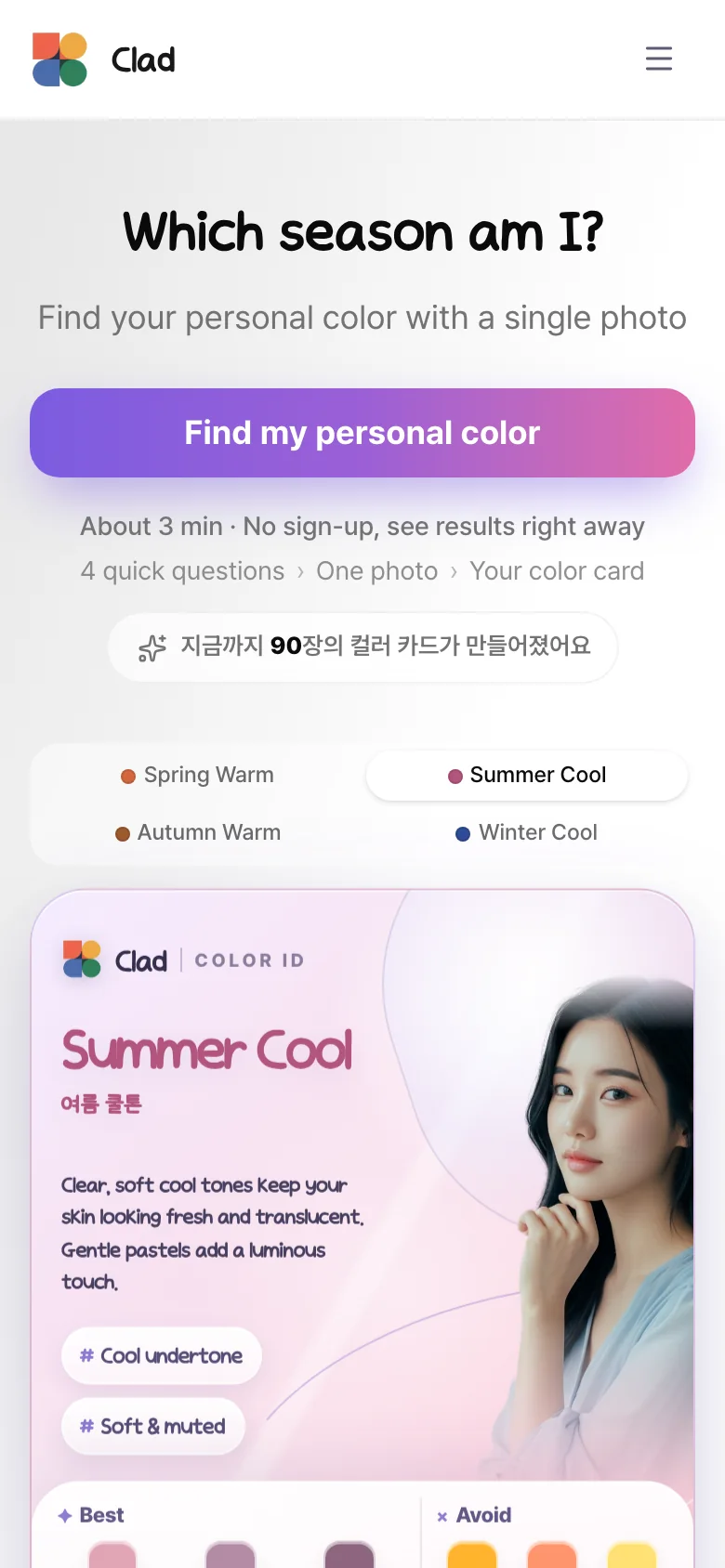
Clad product screen
Live Clad service
The English mobile homepage from the current production service.
The live product captured in its English mobile experience.
Service development record
How the analysis became a usable decision
The same service principles and evidence carry from the moment a photo is submitted to the moment someone understands the result and chooses colors or products.
- 01Observation & evidence
Find where people get stuck after diagnosis
- Question examined
- Where do people curious about personal color face the most friction and uncertainty?
- Decision made
- Focus on a low-friction first analysis and usable next choices, not a replacement for professional diagnosis.
- Evidence used for the decision
- The initial constraints were the time and cost of professional diagnosis, the difficulty of applying a result, and photo variance caused by lighting and editing.
- 02Problem & principle
An understandable starting point, not an absolute answer
- Question examined
- How can a photo-based analysis with uncertainty become a responsible product?
- Decision made
- Explain reasoning and limits, provide a path to retake the photo, and present recommendations as a starting point for exploration.
- Evidence used for the decision
- That principle is now visible in the product: several photos are judged together and the result states whether they agreed, a reanalysis sits beside the previous one with a reason for the difference, and no score or probability is shown anywhere — only the grade, the reason, and the limits.
- 03Hypothesis & scope
One core flow from photo to recommendation
- Question examined
- Which user journey must the first version complete?
- Decision made
- Concentrate on photo preparation, analysis, explanation, palette, and beauty recommendations without recreating every context of professional diagnosis.
- Evidence used for the decision
- The smallest useful result was defined as a choice someone could understand and reference immediately—not merely a type label.
- 04Experience & system
Build the experience around the model
- Question examined
- How should the analysis capability become a dependable service experience?
- Decision made
- Connect input validation, an AI vision workflow, result normalization, palette and recommendation UI, cloud delivery, and observation.
- Evidence used for the decision
- Flutter, Python, Terraform, and explicit error and retry boundaries were selected for a system that can be operated directly at its current scale.
- 05Launch & learning
Treat launch as the start of observation
- Question examined
- Does the result support a real choice beyond producing an interesting answer?
- Decision made
- Use result-explanation views, palette and recommendation exploration, reasons for reanalysis, and qualitative feedback as signals for the next iteration.
- Evidence used for the decision
- Observation currently centers on explanation clarity and recommendation confidence; outcomes are not claimed before meaningful evidence accumulates.
- Current focus
- Clarity of result explanations
- Decision signals
- Palette and recommendation exploration, plus reasons for reanalysis
- Improvement loop
- User feedback → small change → observe again
These are inputs for the next operating or validation decision, not outcomes already achieved.
System architecture
One path from photo to recommendation
Two questions and one photo produce a result card in about three minutes, free and with no account. The card names the season, the colours that suit, and the ones better kept away from the face — every one of them a colour actually sold as a garment dye or a lip shade. The guide that follows can be read as makeup or as men's grooming and everyday style, chosen by a gender question that shapes the guide and never the verdict. Colours can be held against your own photo beside a comparison shade drawn from twenty-four real garment colours, several photos are judged together with the product stating whether they agreed, a reanalysis is placed next to the previous result with a reason for the difference, a season from an earlier in-person diagnosis can be entered before the photo — and if this result differs, the page explains how the two lean, what this verdict rested on, and where the comparison stops, before anything else is asked, and around a hundred real lip products are graded on a lip-specific scale that gives the reason and the limits rather than a score. A result is kept for thirty days unless it is saved to an account. The same experience runs in English.
Input Layer
Photo upload, validation, image preparation
AI Workflow
Vision analysis, prompt pipeline, result normalization
Product Layer
Result explanation, palette UI, recommendation mapping
Operations Layer
Analytics, feedback, iteration backlog
Change history
What changed in this service
Dated by when the change shipped in the product, not by when this page caught up. Lines are added rather than replaced, so what the service withdrew stays readable next to what it gained.
- Added
Let a season from an earlier in-person diagnosis be entered, optionally, before the photo. When this result differs, the result page now explains the difference first — the direction each one leans, the evidence this verdict used, and the limits of comparing the two — with both palettes side by side. The verdict is not changed to match the earlier one, and the satisfaction step no longer repeats a question already answered.
- Added
Re-picked every season's eight recommended colours and four colours to keep away from the face, so each one is a colour actually sold as a garment dye or a lip shade. Dark and neutral colours are no longer winter's alone — summer has soft navy and cool grey, autumn has olive and camel. Results already issued keep the colours they were given.
- Withdrawn
Cut the quiz from three questions to two by dropping the black-clothing question. The quiz asks only what helps the verdict, and the reanalysis comparison says so when a result differs because that question is gone.
- Added
Turned the men's result toward what to wear tomorrow: clothing colour combinations, glasses frames, watches, and hair come first, with lip balm, base, and the lip check opened on request. The saved report carries the same guidance.
- Added
Added a gender choice before the quiz that shapes the guide and never the verdict. Choosing male replaces the makeup guide with men's grooming — a tinted lip balm, a reference range of foundation shades narrowed from the skin brightness measured in the photo, and a hair colour — and anyone can switch between the two guides on the result.
- Withdrawn
Cut the quiz from four questions to three. Measured, the removed question carried no weight in the verdict, so results are unchanged and there is simply one less thing to answer. Results already issued still open as they were.
- Added
Started saying inside the product that the next step beyond a colour result is being built as an app — the fact and the process, with no date or feature promised.
- Added
Opened the same experience in English, so a result can be read and shared outside Korean.
- Added
Added the lip check: around a hundred real lip products graded on a lip-specific scale, giving the reason and the limits instead of a score.
- Added
Extended colour-based recommendations to every product in the catalogue rather than a subset.
- Added
Began judging several photos together and saying out loud whether they agreed, instead of trusting whichever one was uploaded.
- Added
Placed a reanalysis beside the previous result with a reason for the difference.
- Added
Added the colours better kept away from the face, and let any season's colours be held against your own photo.
Current priorities
- 01Improve result explanation
- 02Add better palette visualization
- 03Build the next step beyond a colour result as an app, with no timing or feature promised
- 04Refine recommendation quality
- 05Support more localized beauty guidance
The question I want feedback on now
Which part of the result helped you understand it, and where did choosing from the palette or recommendations become difficult?